

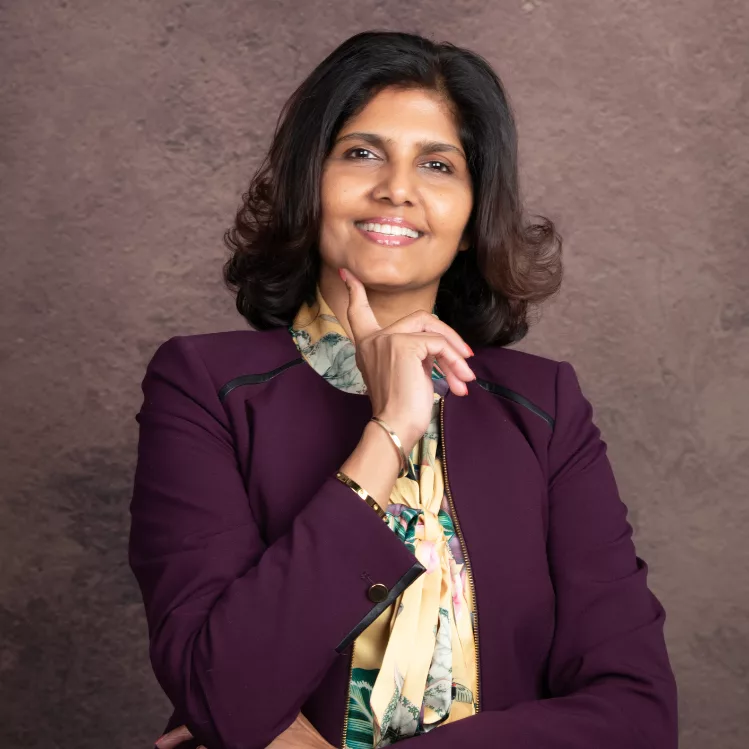
Arokia Antonysamy is a consultant psychiatrist and digital health innovator driven by a simple but urgent question: why do so many people reach mental health crisis before meaningful help begins? After more than two decades working at the front line of psychiatric care, she co-founded MindKonnect to close the gap between early distress and timely, compassionate support. Her work combines clinical rigour, ethical innovation, and a deep commitment to equity, reimagining mental health care as proactive, accessible, and grounded in dignity rather than crisis alone.
“Innovation in mental health means bridging distress and care with compassion and access.”
What inspired you to co-found MindKonnect, and what gap were you hoping to fill in mental health care?
MindKonnect was born from a deep frustration I experienced over two decades as a consultant psychiatrist. I repeatedly saw people reach crisis points not because help didn’t exist, but because access was delayed, fragmented, or intimidating. Many patients struggled in silence for months or years; held back by stigma, long waiting lists, or the complexity of navigating services. By the time they reached specialist care, their suffering had often escalated unnecessarily.
I wanted to bridge the gap between distress and diagnosis. MindKonnect was designed as an early-intervention, clinically robust digital assessment platform that empowers individuals to understand their mental health before they reach breaking point. Unlike many wellness apps, it is rooted in validated psychiatric frameworks and built by clinicians.
Importantly, I was also driven by the principle of equity. MindKonnect is easily accessible, globally scalable, and designed for hard-to-reach and marginalised populations. It offers clarity, dignity, and direction, guiding users to appropriate care pathways when needed. At its core, MindKonnect is about shifting mental health care from reactive crisis management to proactive, compassionate, and patient-centred support.
How do you prioritise features and tools when building a digital health platform from scratch?
My starting point is always the patient, not the technology. As a clinician, I ask one fundamental question: Does this feature meaningfully improve safety, clarity, or access to care? If the answer is no, it doesn’t make the roadmap, no matter how innovative it sounds.
We prioritise features based on three pillars: clinical validity, real-world usability, and ethical responsibility. Every tool must be evidence-based, intuitive for users in distress, and aligned with regulatory and safety standards. My experience developing frameworks like Psychiatric Risk Assessment Tool (PARA) taught me that complexity does not equal effectiveness. Simplicity, clarity, and trust matter far more.
We also co-design with users, carers and clinicians. Feedback from patients, carers, and frontline professionals’ shapes what we build next. Early iterations focus on core assessments and decision-support, before layering advanced features like AI-enabled pattern recognition.
Finally, prioritisation is iterative. We test, learn, refine, and resist feature overload. In mental health, simplicity is a strength. Building slowly, thoughtfully, and ethically ensures that every feature earns its place, and genuinely serves those who need it most.
What lessons did you learn from early failures or challenges in launching innovative projects?
One of my biggest lessons has been that innovation often clashes with rigid systems. Early in my journey, I underestimated how much bureaucracy could slow momentum and drain creative energy. I struggled with environments that prioritised process over purpose and that taught me the importance of choosing the right partners, structures, and governance models early on.
I also learned that being clinically right is not enough. You must communicate your vision in a language that investors, technologists, and policymakers understand. Translating clinical insight into scalable, commercial, and regulatory-ready solutions was a steep learning curve, but a vital one.
Another lesson was learning when to pause and refine. Early failures helped me appreciate the value of iteration rather than perfection. I became more comfortable piloting ideas, gathering feedback, and adapting quickly.
Most importantly, I learned resilience. Innovation requires tolerance for uncertainty and criticism. Every challenge sharpened my leadership, strengthened my strategic thinking, and reinforced my commitment to building solutions that are not only innovative, but sustainable, ethical, and truly impactful.
How do you validate that a mental health innovation will truly benefit users before scaling?
Validation starts long before scale. As a psychiatrist and researcher, I insist on grounding every innovation in clinical evidence and real-world testing. For MindKonnect, this meant designing assessments based on established psychiatric frameworks and validating them with clinicians and users from the outset.
We pilot carefully, gathering both quantitative outcomes such as engagement, symptom clarity, and referral appropriateness and qualitative feedback about user experience, emotional safety, and trust. Mental health tools must feel supportive, not intrusive or overwhelming.
Equally important is clinician validation. If frontline professionals don’t trust or understand the tool, it will never integrate meaningfully into care pathways. I involve psychiatrists, psychologists, and allied professionals early to stress-test assumptions and identify risks.
We also assess unintended consequences. Could this tool increase anxiety? Could it delay help-seeking? These ethical questions are central to validation.
Only when a solution demonstrates safety, clarity, and measurable benefit and aligns with regulatory expectations, do we consider scaling. In mental health, responsible growth is not optional; it is fundamental.
Which partnerships or collaborations have been most pivotal for MindKonnect’s growth?
Collaboration has been essential to MindKonnect’s evolution. Some of the most pivotal partnerships have been with clinical experts, community organisations, and social-impact networks that share our values around accessibility and equity.
Clinically, working with global psychiatry experts ensured that our assessments are robust, culturally sensitive, and relevant across different healthcare systems. These collaborations protected the clinical integrity of the platform as we scaled.
Equally important have been partnerships with community and third-sector organisations that support underserved populations. They helped us reach individuals who might never engage with traditional mental health services due to stigma or mistrust.
From a growth perspective, collaborations with academic institutions like the University of Warwick enterprise programme, policy initiatives, and Health Innovation Networks and partnership with Investors passionate about mental health have strengthened our credibility and visibility.
I believe the future of digital mental health is not built in isolation. It is built through ecosystems, where clinicians, users, technologists, communities, and policymakers work together to deliver care that is ethical, scalable, and human at its core.
How do you maintain a patient-centred mindset while driving startup growth and innovation?
For me, patient-centred care is non-negotiable. It is the anchor that keeps innovation ethical. I remind myself constantly that behind every data point is a human being, often vulnerable, scared, or unheard.
Practically, this means embedding patient experience into every decision. We ask: Does this reduce distress? Does it increase understanding? Does it preserve dignity? If growth pressures compromise those principles, we slow down.
I also draw on my clinical identity. Continuing to work closely with patients keeps me grounded in real-world needs rather than abstract metrics. Their stories challenge assumptions and recalibrate priorities.
From a leadership perspective, I foster a culture where empathy and safety matter as much as speed. Innovation should augment care, not replace human connection.
Ultimately, sustainable growth comes from trust. When users feel respected and supported, engagement follows naturally. Patient-centred design is not a constraint on innovation, it is what makes innovation meaningful and lasting.
How do you see emerging technologies reshaping mental health startups in the next five years?
Over the next five years, I see technology shifting mental health care from episodic, reactive models to continuous, preventative, and personalised support. AI, when used responsibly, will help identify subtle patterns of risk, relapse, or deterioration long before crisis points are reached.
However, the most important shift will not be technical, it will be ethical. The startups that succeed will be those that combine innovation with regulation, transparency, and clinical oversight. Unregulated tools may gain attention, but they will not earn trust.
We will also see greater integration between digital platforms and traditional healthcare systems. Standalone apps will give way to tools that support clinicians, inform decision-making, and improve outcomes across entire care pathways.
Importantly, technology will amplify, not replace human care. The future belongs to platforms that respect the complexity of mental health and use technology as a second listener, not a substitute for compassion.
What strategies have helped you attract investment or support for your mental health innovations?
Credibility has been my strongest asset. My clinical background, research track record, and previous innovations such as PARA and MaZon, demonstrate that I can translate ideas into real-world impact. Investors want evidence of execution, not just vision.
I also lead with purpose. MindKonnect is not a solution in search of a problem; it addresses a clearly defined gap with measurable social and clinical impact. That clarity resonates with mission-driven investors and partners.
Another key strategy has been transparency. I am open about risks, regulatory challenges, and timelines. Trust is built when stakeholders feel informed rather than sold to.
Finally, I leverage storytelling. Sharing real patient experiences ethically and anonymously, helps investors understand why this work matters. When innovation is grounded in both data and human need, support follows more naturally.
How do you balance the urgency to innovate with the responsibility to ensure patient safety?
In mental health, speed without safety is dangerous. I balance urgency and responsibility by adopting a “safety-first, scale-second” philosophy. Every innovation undergoes rigorous clinical review, ethical scrutiny, and iterative testing before wider release.
I also work closely with regulatory frameworks rather than viewing them as obstacles. Compliance is not a barrier to innovation, it is what protects patients and strengthens long-term credibility.
When faced with pressure to move faster, I return to first principles: Would I be comfortable using this tool with my own patients or family members? If the answer is no, we slow down.
True innovation is not about being first; it is about being right. In healthcare, trust is earned through consistency, transparency, and accountability. That balance is what allows innovation to endure.
What advice would you give other healthcare professionals looking to launch their own tech-enabled solutions?
Start with the problem, not the product. Spend time deeply understanding the unmet need from a patient and clinician perspective before building anything. Your clinical insight is your greatest strength, use it.
Secondly, build multidisciplinary teams early. Healthcare innovation sits at the intersection of medicine, technology, ethics, and business. You don’t need to be an expert in everything, but you must respect each domain.
Be prepared for discomfort. Innovation challenges existing systems, and resistance is inevitable. Resilience, adaptability, and clarity of purpose will carry you through setbacks.
Finally, never lose sight of why you started. Technology is a tool, not the mission. If your solution improves lives, protects dignity, and enhances care, the impact will follow. And when it does, it will be deeply worth the journey.

Startup Business Forum will be featuring high-energy keynote speakers, inclusive panel discussions, and breakout sessions with leaders at the forefront of the technology and business sectors. The Forum offers delegates the opportunity to acquire tactical